


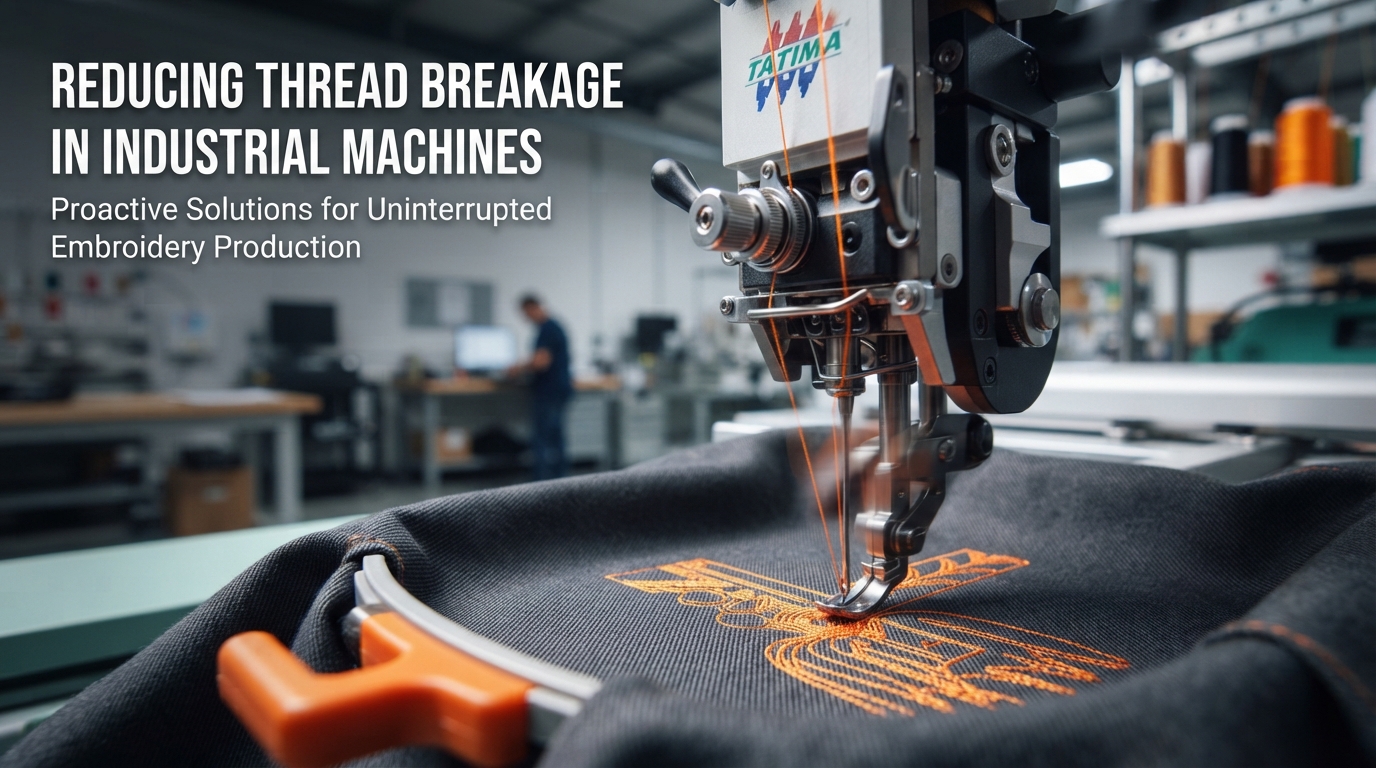
Thread Breakage: The #1 Productivity Killer in Embroidery
Thread breakage interrupts production, wastes fabric, and frustrates operators. In a commercial embroidery facility running multiple machines, even a 5% reduction in thread breaks can translate to significant productivity gains. The good news: most thread breakage is caused by just a handful of identifiable and fixable issues.
These 10 tips are based on real-world experience servicing Tajima, Barudan, Juki, and Brother machines in Pakistan and for export clients in UAE, UK, USA, and Saudi Arabia.
Tip 1: Replace Needles More Frequently
This is the single most impactful action you can take. A dull needle tip tears rather than pierces fabric, generating heat and friction that weaken thread. Most operators replace needles too infrequently. The rule: every 8–10 hours of stitching time, or immediately after hitting a hard object.
Use the correct needle size for your thread: 75/11 for most 120/2 polyester, 80/12 for heavier fabrics or metallic threads, 65/9 for lightweight fabrics with 150/2 thread.
Tip 2: Inspect the Rotary Hook
A worn or burred rotary hook is the second most common cause of thread breakage. The hook beak cuts through thread instead of smoothly catching the loop. Run your fingernail across the hook beak — if you feel any roughness, replace the hook. Don't try to polish it yourself; improper polishing changes the hook geometry and causes skipped stitches.
Tip 3: Check the Thread Path for Burrs
Thread runs over many surfaces between the spool and needle: the spool pin, thread guide eyelet, tensioner discs, take-up lever, needle bar guide, and needle eye. Any burr or rough edge on these surfaces will shred thread. Run a piece of white cotton thread slowly over each contact point — if it snags or frays, that point needs smoothing or replacement.
Tip 4: Adjust Upper Thread Tension
Tension too high is a leading cause of thread breakage. The upper tension should be the minimum needed to pull a small amount of bobbin thread to the underside of the fabric — typically visible as a thin line on the back. If you see no bobbin thread on the back, tension is too low. If the top stitching is pulling up and the front looks knotted, tension is too high — and breaking threads follows.
Tip 5: Check Thread Spool Quality
Low-quality thread breaks more. Issues include: uneven twist (causes weak spots), over-wound spools (thread is under constant tension), and poor lubricant application (thread doesn't run smoothly through guides). Switch to a reliable wholesale thread supplier with consistent quality control.
Tip 6: Don't Use Old or Humidity-Damaged Thread
Rayon thread especially is moisture-sensitive. In humid environments, rayon absorbs water, swells, and becomes brittle when it dries on the spool. This leads to sudden thread breaks mid-run. Store thread in a cool, dry area away from direct sunlight.
Tip 7: Verify Needle Insertion & Orientation
A needle installed slightly high, low, or rotated can miss the hook's catch point, causing erratic thread breakage. Insert the needle fully until it contacts the needle clamp stop. The long groove (scarf) should face the front of the machine on most industrial embroidery machines.
Tip 8: Clean the Thread Path Regularly
Lint, thread fragments, and oil residue build up in tensioner discs, the rotary hook race, and needle bar guides. This creates friction that weakens thread. Clean these areas at the start of every shift using compressed air and a lint brush.
Tip 9: Match Thread Weight to Design Density
High-density fill areas put more thread through the fabric per square centimeter. If you're stitching very dense fills at high speed with thick thread (120/2), thread breakage can increase due to the physical limitation of fabric penetration. Consider reducing design density in the digitizing software, or switch to 150/2 thread for very dense designs.
Tip 10: Check the Needle Plate & Presser Foot
A grooved needle plate or worn presser foot can snag thread at the worst possible moment — as it forms the stitch. Inspect the needle hole in the plate for enlargement or rough edges. If the hole has become oval-shaped from needle deflection, replace the needle plate.
When Nothing Works: Call for Service
If you've systematically addressed all of the above and still have persistent thread breakage on one head, the issue is likely in the timing or hook-to-needle clearance, which requires a trained technician. Incorrect timing causes the hook to either miss the thread loop or pinch it — both result in breakage.
SA Embroidery supplies replacement parts for all common embroidery machine brands. Contact us for parts or technical support.
Need embroidery machine parts?
WhatsApp us. We respond within 24 hours, Mon–Sat
Frequently Asked Questions
Common questions about this topic
1Why does thread only break on one needle head?
When breakage is isolated to one head, the issue is almost always with that head's rotary hook, needle, presser foot, or timing. Start by replacing the needle, then inspect the hook. If it persists, the head may need timing adjustment.
2Does the type of thread affect breakage rate?
Yes. Polyester thread has higher tensile strength than rayon and typically breaks less, especially on high-speed machines and tight curves. Metallic and specialty threads break most easily and require lower machine speed and special needles.
3How do I know if my tension is causing thread breakage?
Tension-caused breakage typically happens at the same point in a design (where the stitch direction changes sharply or where the take-up lever accelerates). Try reducing upper tension by half a unit and run a test — if breakage reduces, tension was the cause.
4Where can I buy quality replacement parts for my Tajima machine in Pakistan?
SA Embroidery in Faisalabad stocks a comprehensive range of Tajima, Barudan, Juki, and Brother spare parts. We ship within Pakistan and internationally. Contact us via WhatsApp at +92-316-793-7030.