


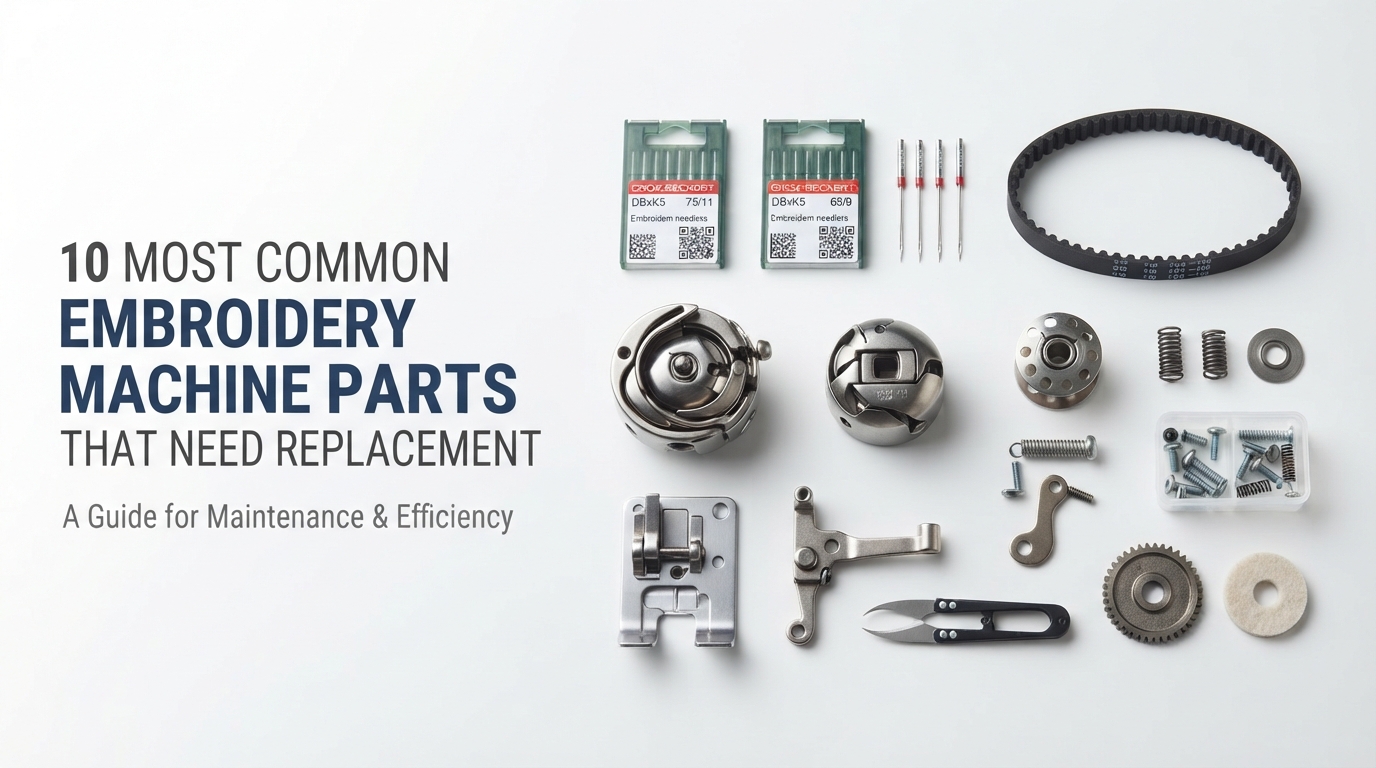
Why Timely Part Replacement Prevents Costly Downtime
In a commercial embroidery operation, machine downtime is lost revenue. A single multi-head Tajima or Barudan machine can produce thousands of pieces per day. When it stops due to a failed part — especially one that could have been predicted and replaced — the cost in lost production far exceeds the price of the part itself.
Knowing which parts wear fastest and what symptoms to look for is the foundation of smart preventive maintenance. Here are the 10 parts that embroidery machine operators replace most frequently.
1. Needles — Replace Every 8–10 Stitching Hours
Needles are the most frequently replaced part on any embroidery machine. A needle runs through fabric thousands of times per minute. As it wears, the sharp tip becomes blunt, causing fabric damage, skipped stitches, and thread breakage.
Replace when: You notice thread breakage, skipped stitches on the same head, or after 8–10 hours of stitching. Always replace after hitting a hard backing or zipper accidentally.
2. Rotary Hook — Inspect Every 500 Hours
The rotary hook is responsible for catching the needle thread loop to form a lockstitch. The hook point is precision-ground to within microns. Once it wears or chips, it causes skipped stitches and thread shredding.
Replace when: You see skipped stitches across multiple color changes, thread shredding near the needle eye, or visible wear/burr on the hook beak. A simple fingernail test across the hook point reveals rough spots.
3. Bobbin Case — Replace When Tension Becomes Inconsistent
The bobbin case holds the lower thread and controls its tension. The internal spring that creates tension weakens over time. A worn bobbin case spring causes looping on the underside of embroidery (the tension is too loose) or thread pull-through on the top (tension too tight).
Replace when: You can't achieve consistent tension despite adjusting the tension screw, or the case shows visible wear on its surface.
4. Presser Foot — Replace When Bent or Worn
The presser foot holds fabric flat as the needle punches through. A bent or worn presser foot causes fabric puckering, uneven stitch density, and needle breakage. Check the bottom face of the presser foot for grooves or flat spots.
5. Needle Plate (Throat Plate) — Inspect Monthly
Needle plates develop grooves where the needle passes repeatedly. These grooves snag thread and cause breakage. A scratched needle plate surface also damages delicate fabrics.
Replace when: You see visible grooves, the needle hole has enlarged, or delicate fabrics are snagging.
6. Thread Tensioner Discs — Replace Every 2 Years or When Damaged
Upper thread tensioners apply consistent drag to the thread as it runs from the spool to the needle. Worn tensioner discs slip, creating inconsistent tension. This leads to poor stitch quality across entire design sections.
7. Upper & Lower Knives (Trimmer Assembly) — Replace Every 3–6 Months
Auto-trim knives cut the thread after each color change or jump stitch. Dull knives leave long thread tails, cause thread nesting, or fail to cut entirely.
Replace when: Thread tails are inconsistently long, the trimmer fails to cut cleanly, or you hear a clicking/grinding sound during trim cycles.
8. Bobbin Thread Monitor Spring — Replace Annually
This small spring senses when the lower bobbin is running low and alerts the operator. A broken monitor spring causes the machine to run out of bobbin thread mid-design without alerting the operator — wasting fabric.
9. Frame Drive Belt — Inspect Every 6 Months
The frame drive belt moves the embroidery hoop in X and Y directions. A cracked or stretched belt causes positional errors — stitches land in the wrong place, ruining registration across multi-head machines.
Replace when: You notice slight positional drift across heads, or the belt shows visible cracking or fraying.
10. Color Change Motor Brushes — Replace Every 1,000 Hours
The color change mechanism rotates the needle case to switch thread colors. The motor that drives it uses carbon brushes that wear over time, eventually causing slow or failed color changes.
Replace when: Color changes are slow, incomplete, or producing grinding sounds.
Preventive Maintenance Saves Money
Keeping a small stock of high-turnover parts — needles, bobbins, bobbin cases, trimmer knives — ensures you can swap parts immediately when needed. SA Embroidery supplies all of these parts in bulk quantities to factories in Pakistan, UAE, UK, USA, and Saudi Arabia.
Browse our full product catalogue or contact us to discuss a maintenance supply package for your facility.
Need embroidery machine parts?
WhatsApp us. We respond within 24 hours, Mon–Sat
Frequently Asked Questions
Common questions about this topic
1How often should I replace embroidery machine needles?
Replace needles every 8–10 hours of stitching time under normal conditions. Replace immediately if you hit a hard object, notice skipped stitches, or thread breakage on a single head.
2What causes skipped stitches in an embroidery machine?
Skipped stitches are most commonly caused by a worn or damaged rotary hook, a bent needle, incorrect needle size for the thread, or improper timing between needle and hook.
3How do I know if my bobbin case needs replacing?
If you can't achieve consistent tension despite adjusting the tension screw, or the underside of your embroidery shows looping or thread pull-through, the bobbin case spring is likely worn.
4Do you sell embroidery machine parts in bulk quantities?
Yes, SA Embroidery offers bulk pricing on all spare parts. Minimum order quantities vary by part. Contact us via WhatsApp or our quote form for bulk pricing.