


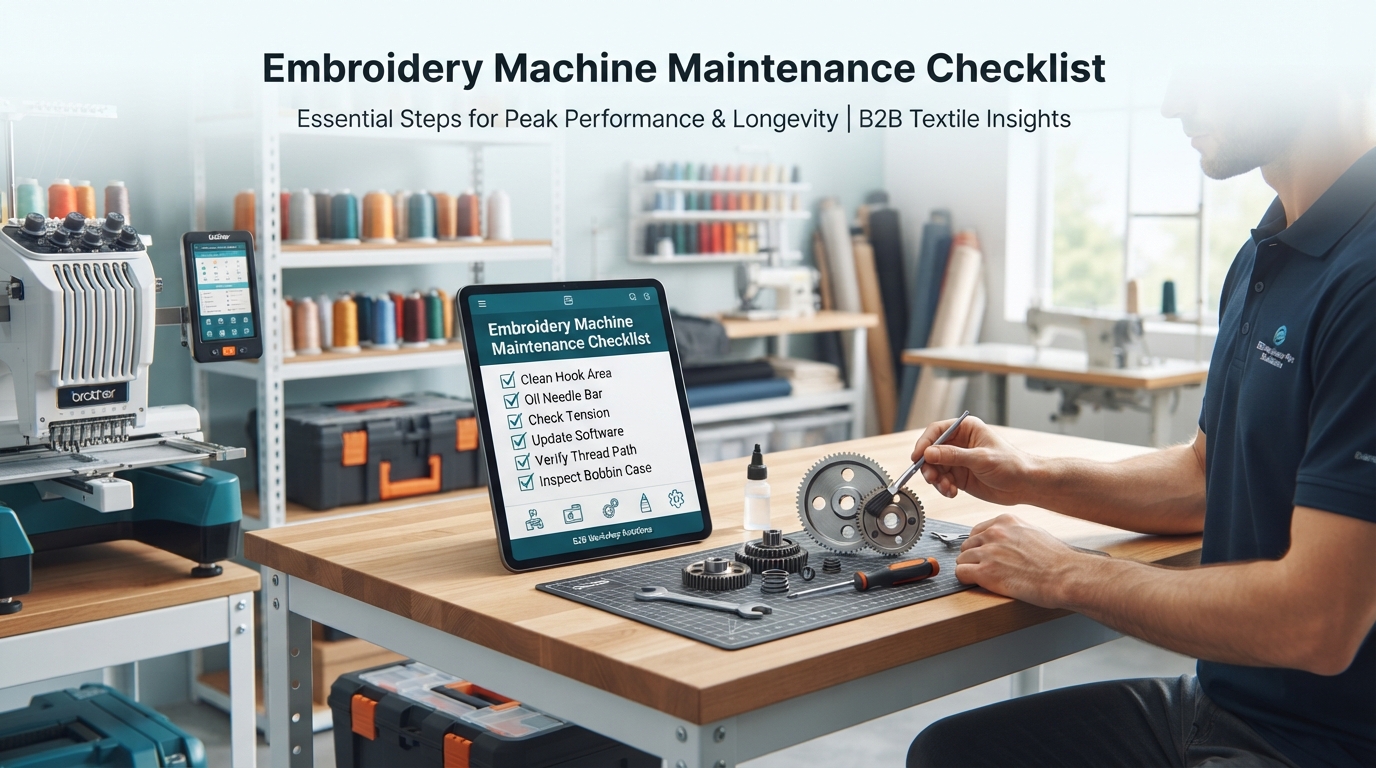
Why Preventive Maintenance Is Non-Negotiable
Industrial embroidery machines are precision instruments running at up to 1,200 stitches per minute. Every hour of operation generates lint, metal filings, and oil breakdown. Without regular maintenance, these contaminants cause accelerated wear, poor stitch quality, and eventually costly breakdowns.
A structured maintenance schedule keeps your Tajima, Barudan, Juki, or Brother machine running at peak efficiency for years — and dramatically reduces unplanned downtime. Print this checklist and post it at every machine.
Daily Maintenance Checklist (Every Shift)
- ✅ Clean the hook race — Use a small brush and compressed air to remove lint from the rotary hook race and bobbin area. Lint buildup in the hook race causes friction and eventual hook wear.
- ✅ Lubricate the rotary hook race — Apply one drop of embroidery machine oil to the hook race. Do not over-oil.
- ✅ Check and replace needles if needed — Inspect needle tips for bluntness or bending. Replace after 8–10 hours of stitching.
- ✅ Check bobbin thread level — Never run out of bobbin mid-design. Wind and stage backup bobbins at the start of each shift.
- ✅ Inspect thread path — Run thread slowly and check all guides for burrs, especially after changing thread colors.
- ✅ Test upper and lower tension — Stitch a test swatch and verify tension balance before starting production.
- ✅ Clear around the needle plate — Remove thread fragments and fabric scraps that can jam between the plate and presser foot.
Weekly Maintenance Checklist
- ✅ Deep-clean all hook races — Use a cotton swab with isopropyl alcohol to remove old oil and accumulated debris from each hook race.
- ✅ Check and clean tensioner discs — Remove upper thread from tensioners and blow compressed air between the discs. Inspect for wear or contamination.
- ✅ Inspect needle plates — Check the needle hole for enlargement or grooves. Replace if the hole is no longer circular.
- ✅ Check presser feet — Inspect for bending or worn contact surface. A worn presser foot causes fabric puckering.
- ✅ Oil head components — Apply machine oil to all designated lubrication points as specified in your machine's manual. Typically includes needle bar, take-up lever, and presser foot bar.
- ✅ Inspect trimmer knives — Check that the thread cutter is cutting cleanly with no ragged tails. Replace upper or lower knife if needed.
- ✅ Clean the machine bed and arm — Wipe down external surfaces with a clean cloth. Remove thread clippings from inside the arm.
Monthly Maintenance Checklist
- ✅ Inspect rotary hooks closely — Check the hook beak for wear using a magnifier. Run fingernail test. Replace any hooks showing wear.
- ✅ Check bobbin cases — Test tension consistency on each bobbin case. Replace cases showing inconsistent tension that can't be corrected by the tension screw.
- ✅ Lubricate the pantograph (X/Y frame drive) — Apply lubricant to guide rails and drive screws as per machine manual.
- ✅ Inspect drive belts — Check for cracking, fraying, or stretching. Replace belts that show visible wear.
- ✅ Check motor brush wear — On machines with DC motor color changers, inspect carbon brush wear and replace before they reach minimum length.
- ✅ Full timing check — Verify hook-to-needle timing on all heads using slow-run mode. Correct any heads that are out of specification.
- ✅ Software/firmware update check — Check if your machine's control unit has available firmware updates for performance improvements.
Annual Service (Professional)
Once per year, have a qualified technician perform:
- Complete disassembly and cleaning of all heads
- Bearing inspection and replacement where needed
- Full timing calibration across all heads
- Electrical connection inspection
- Frame alignment check
Recommended Lubricants & Products
Use only embroidery-grade machine oil (like Tajima oil or equivalent). Never use WD-40 or general-purpose oil — these are too thin, evaporate quickly, and leave gummy residue. For the hook race, use oil sparingly; for the needle bar and take-up lever, slightly more.
Keeping a Maintenance Log
Record every maintenance action with the date, head number, and action taken. This log helps identify patterns — if head #3 consistently needs more frequent needle replacement than others, it may indicate a timing issue or worn hook.
SA Embroidery supplies all maintenance parts including oils, needles, hooks, bobbins, and trimmer knives. Browse our full product range or contact us for a maintenance supply package.
Need embroidery machine parts?
WhatsApp us. We respond within 24 hours, Mon–Sat
Frequently Asked Questions
Common questions about this topic
1How often should I oil my embroidery machine?
Apply one drop of embroidery-grade machine oil to the rotary hook race at the start of each shift. Oil other mechanical components (needle bar, take-up lever) weekly or as indicated by your machine's manual. Never use WD-40 or general-purpose oils.
2What happens if I don't maintain my embroidery machine regularly?
Neglected maintenance causes lint buildup in the hook race (leading to hook wear), dried oil on moving parts (causing stiff movement and vibration), worn needles (causing poor stitch quality and thread breakage), and premature failure of bobbins and tensioners.
3How do I clean embroidery machine tensioner discs?
Remove the thread from the upper tensioners. Blow compressed air between the tensioner discs to remove lint. If discs are sticky with old oil, use a lint-free cloth lightly dampened with isopropyl alcohol to clean the disc surfaces. Allow to dry before rethreading.
4Is it worth buying a spare parts kit for my machine?
Absolutely. Keeping a supply of high-turnover parts — needles, bobbins, a spare rotary hook, bobbin cases, and trimmer knives — ensures you can resume production immediately when a part fails rather than waiting for delivery.