


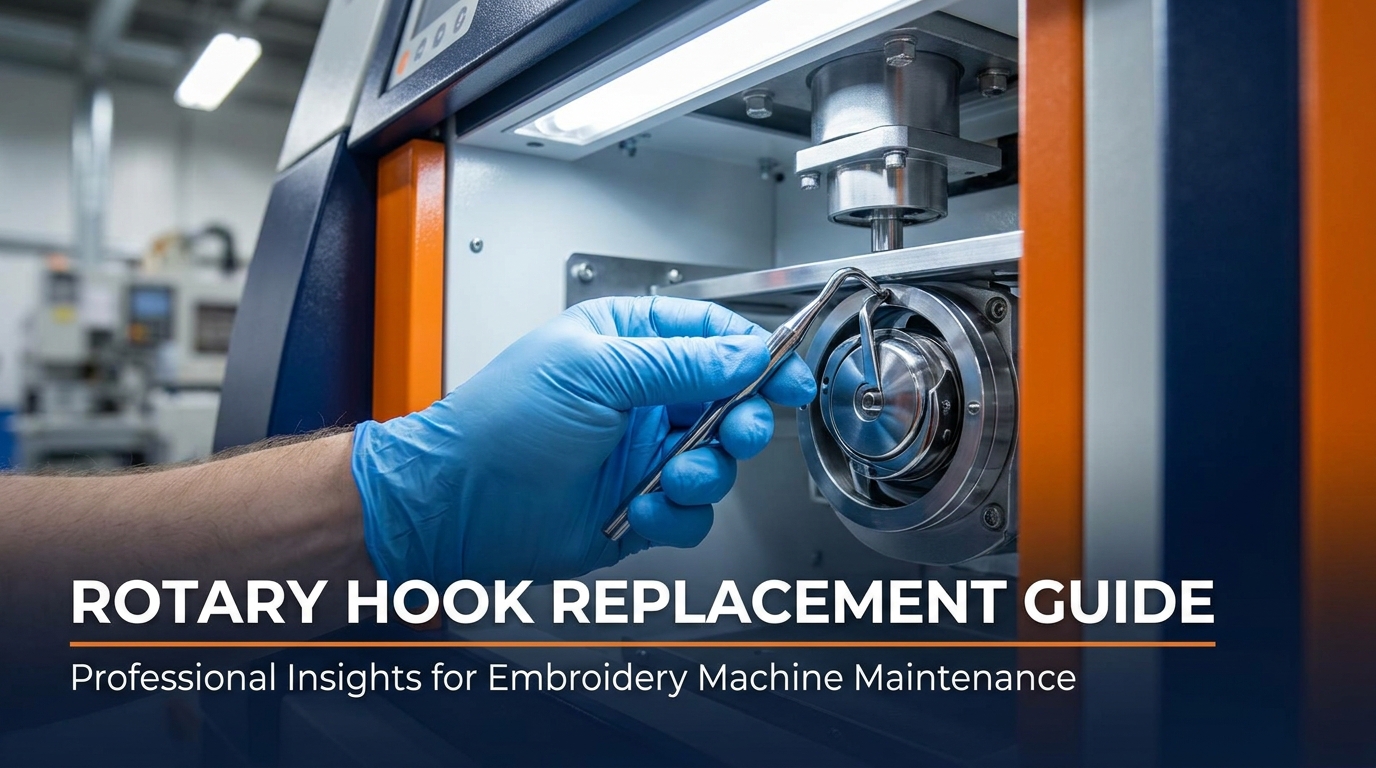
What Is a Rotary Hook and Why It's Critical
The rotary hook is one of the most important — and most misunderstood — components in an industrial embroidery machine. It sits below the needle plate and rotates in sync with the needle to catch the upper thread loop and wrap it around the bobbin thread, forming a lockstitch.
Every stitch your machine makes passes through the rotary hook. At 1,000 SPM (stitches per minute), that's 60,000 interactions per hour between needle and hook. Even precision-ground steel wears under this load.
Types of Rotary Hooks Used in Industrial Embroidery Machines
Full Rotary Hook (Standard)
Used in most multi-head embroidery machines including Tajima and Juki. The hook makes a complete 360° rotation per two needle strokes. High-speed models can operate at 1,200+ SPM.
Semi-Rotary Hook (Oscillating)
Used in some older Barudan models and certain single-head machines. The hook oscillates back and forth rather than rotating fully. Lower maintenance requirement but slower maximum speed.
Large Capacity Hook
Available for machines set up for thick embroidery thread or zari/metallic work. Accommodates larger bobbins for longer uninterrupted run time.
Signs Your Rotary Hook Needs Replacement
Don't wait for a complete failure. Look for these early warning signs:
- Skipped stitches — especially on the same needle head repeatedly
- Thread shredding — thread fraying or breaking at the needle eye
- Thread loop on underside — hook is not catching the thread loop consistently
- Visible burr or flat spot — run your fingernail across the hook beak; any roughness indicates wear
- Rattling sound — the hook race may be worn or the hook is not seated properly
Step-by-Step Rotary Hook Replacement
Tools Needed
- Small flathead screwdriver
- Needle-nose pliers
- Lint-free cloth
- Machine oil (embroidery-grade)
Procedure
- Power off the machine and remove the needle and presser foot on the head being serviced.
- Remove the throat plate by unscrewing the two screws that hold it in place.
- Remove the bobbin case — open the latch and pull the bobbin case straight out.
- Access the rotary hook — some models have a retaining clip; others require loosening a set screw on the hook shaft.
- Remove the old hook by lifting it off the hook shaft. Note the orientation carefully.
- Clean the hook race with a lint-free cloth. Remove any lint, oil residue, or metal filings.
- Install the new hook in the same orientation. Ensure it seats fully against the shaft flange.
- Apply a single drop of machine oil to the hook race.
- Check timing — reinstall the bobbin case, throat plate, and needle. Run the machine slowly to verify stitch formation before returning to full speed.
Hook Timing: When to Adjust
If you're still getting skipped stitches after replacing the hook, the problem may be timing. The hook beak should pass the needle's scarf (the indentation above the eye) when the needle is 2–2.4mm above its lowest point. Timing adjustment is brand-specific and requires consulting your machine's service manual. If you're not comfortable doing this yourself, contact a certified Tajima or Barudan service technician.
How Long Does a Rotary Hook Last?
Under normal commercial use with proper lubrication, a quality rotary hook lasts 500–1,000 operating hours. Hooks used on metallic or coarse thread wear faster. Using a hook beyond its service life risks damaging the hook race (a much more expensive repair).
Sourcing Quality Rotary Hooks from Pakistan
SA Embroidery stocks OEM-compatible rotary hooks for Tajima, Barudan, Juki, Brother, and ZSK machines. We supply in individual units and in sets of 6, 9, or 15 (matching your machine head count). All hooks come with a 90-day warranty against manufacturing defects.
We export to UAE, Saudi Arabia, UK, USA, and across the Gulf. Contact us with your machine model and head count for a quote.
Need embroidery machine parts?
WhatsApp us. We respond within 24 hours, Mon–Sat
Frequently Asked Questions
Common questions about this topic
1How do I know if the problem is the rotary hook or the needle timing?
Start by replacing the needle — it's cheaper and faster. If skipped stitches persist after a new needle, inspect the hook beak for wear. If the hook looks fine, check timing with a slow-run test watching the needle-hook relationship at the lowest needle position.
2Can I use any rotary hook brand on my Tajima machine?
OEM-compatible hooks from reputable suppliers work well. However, avoid extremely cheap hooks — they often have poor surface finish on the hook beak which causes rapid wear of the hook race. SA Embroidery only supplies hooks that meet OEM specifications.
3Do you sell complete hook sets for multi-head machines?
Yes, we supply matched hook sets for 6-head, 9-head, 12-head, and 15-head machines. Using matched sets ensures consistent stitch quality across all heads.
4How often should I lubricate the rotary hook?
Apply one drop of embroidery machine oil to the hook race at the start of each shift (every 8 hours). Over-lubrication attracts lint and causes just as many problems as under-lubrication.