


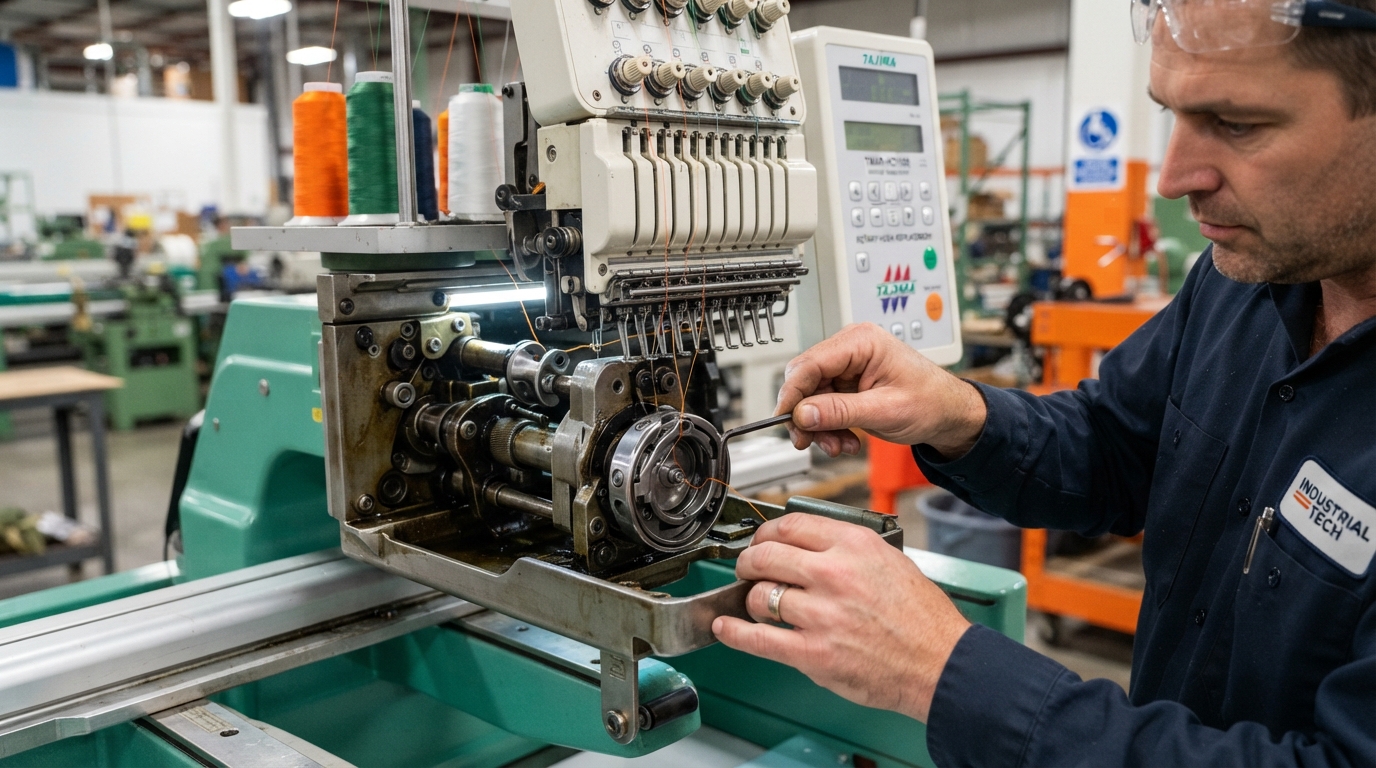
Why Needle Selection Matters More Than Most Operators Realise
The needle is the most frequently changed part on any embroidery machine and also the most frequently blamed when something goes wrong — yet choosing the right needle type and size for the job is often overlooked. The right needle prevents thread breakage, fabric damage, and skipped stitches. The wrong needle causes all three.
This guide covers everything you need to know about industrial embroidery machine needles.
The DB x K5 Needle: Industry Standard
Almost all multi-head commercial embroidery machines — including Tajima, Barudan, Juki, Brother, ZSK, SWF, and Happy — use the DB x K5 needle system. The designation means:
- DB: Double-sided flat shank needle for industrial embroidery machines
- K5: Standard eye shape for embroidery thread
DB x K5 needles come in different point types and sizes to suit different fabrics and thread types.
Needle Point Types
Sharp Point (Standard)
The default needle for most embroidery work on woven fabrics — shirts, caps, bags, and most synthetic textiles. The sharp point pierces individual fabric threads cleanly.
Ballpoint (SES / SUK)
Designed for knit and stretch fabrics (t-shirts, fleece, jersey). A ballpoint needle pushes aside fabric threads rather than piercing them, preventing runs and snags in knit materials. Use a SES or SUK ballpoint needle whenever embroidering on stretchy or knit fabrics.
Stretch Needle
A specialty ballpoint with an extended scarf (groove above the eye) for highly elastic fabrics like Lycra or spandex. The extended scarf prevents skipped stitches caused by fabric deflecting the needle.
Needle Sizes Explained
DB x K5 needles are sized using a European metric system (65 through 110) and a parallel American system (9 through 18):
| EU Size | US Size | Best For |
|---|---|---|
| 65 | 9 | Very lightweight fabrics (organza, chiffon) with fine 150/2 thread |
| 75 | 11 | Standard fabrics (shirts, polos) — most versatile size for 120/2 thread |
| 80 | 12 | Medium-weight fabrics (canvas bags, denim shirts) |
| 90 | 14 | Heavy fabrics (denim, thick canvas) and metallic thread |
| 100 | 16 | Very heavy fabrics (leather, heavy canvas) |
Choosing the Right Needle for Your Thread
- Polyester 120/2 thread: Size 75/11 sharp on most fabrics
- Rayon 120/2 thread: Size 75/11 sharp, or 80/12 on denser fabrics
- Metallic thread: Size 90/14 with a metallic-specific needle (larger eye to prevent thread shredding)
- Fine 150/2 thread: Size 65/9 for delicate fabrics, 70/10 for standard fabrics
- Wool or thick specialty thread: Size 100/16 or 110/18
Signs Your Needle Needs Replacing
- Thread breaking repeatedly on one head
- Skipped stitches (especially on satin columns and directional stitch changes)
- Popping or clicking sound as the needle enters fabric
- Fabric holes appearing larger than normal (needle is dull and tearing rather than piercing)
- Visible bend or burr on the needle — even a 1° bend causes skipped stitches
Needle Replacement Interval
The standard recommendation is every 8–10 hours of stitching time. However, this varies by fabric type:
- Soft fabrics: 10–12 hours
- Standard woven: 8 hours
- Denim / canvas: 4–6 hours
- Backing-heavy designs: 6 hours
Always replace immediately after a needle strike event (hitting a zipper, hoop, or hard object).
Correct Needle Installation
- Raise the needle bar to its highest position
- Loosen the needle clamp screw with the correct screwdriver
- Insert the needle with the flat side facing toward the back (for most DB x K5 machines) and push it fully up until it contacts the stop
- Tighten the clamp screw firmly — a loose needle causes timing errors
Buying Embroidery Needles in Bulk from Pakistan
SA Embroidery supplies DB x K5 needles in all common sizes and point types. We sell in boxes of 100 and cases of 1,000. Minimum order: 5 boxes. We export to UAE, Saudi Arabia, UK, USA, and Gulf countries via FedEx and DHL.
Contact us for a wholesale price list or browse our needle range.
Need embroidery machine parts?
WhatsApp us. We respond within 24 hours, Mon–Sat
Frequently Asked Questions
Common questions about this topic
1What needle should I use for embroidery on t-shirts?
Use a DB x K5 ballpoint (SES or SUK point) needle in size 75/11. The ballpoint prevents the needle from splitting knit fabric threads, which causes runs and snags in jersey and t-shirt materials.
2Can I use sewing machine needles in my embroidery machine?
No. Home sewing machine needles (HA x 1) use a round shank and are not compatible with industrial embroidery machines which require DB x K5 flat-shank needles. Using the wrong needle causes machine damage.
3How many needles should I stock per head per month?
A conservatively managed commercial operation uses approximately 2–4 needles per head per month under standard working conditions. For heavy use or difficult fabrics, stock more generously.
4Do you supply metallic embroidery needles?
Yes, SA Embroidery stocks metallic thread needles in sizes 90/14 and 100/16 with enlarged eyes designed to prevent metallic thread from fraying.