


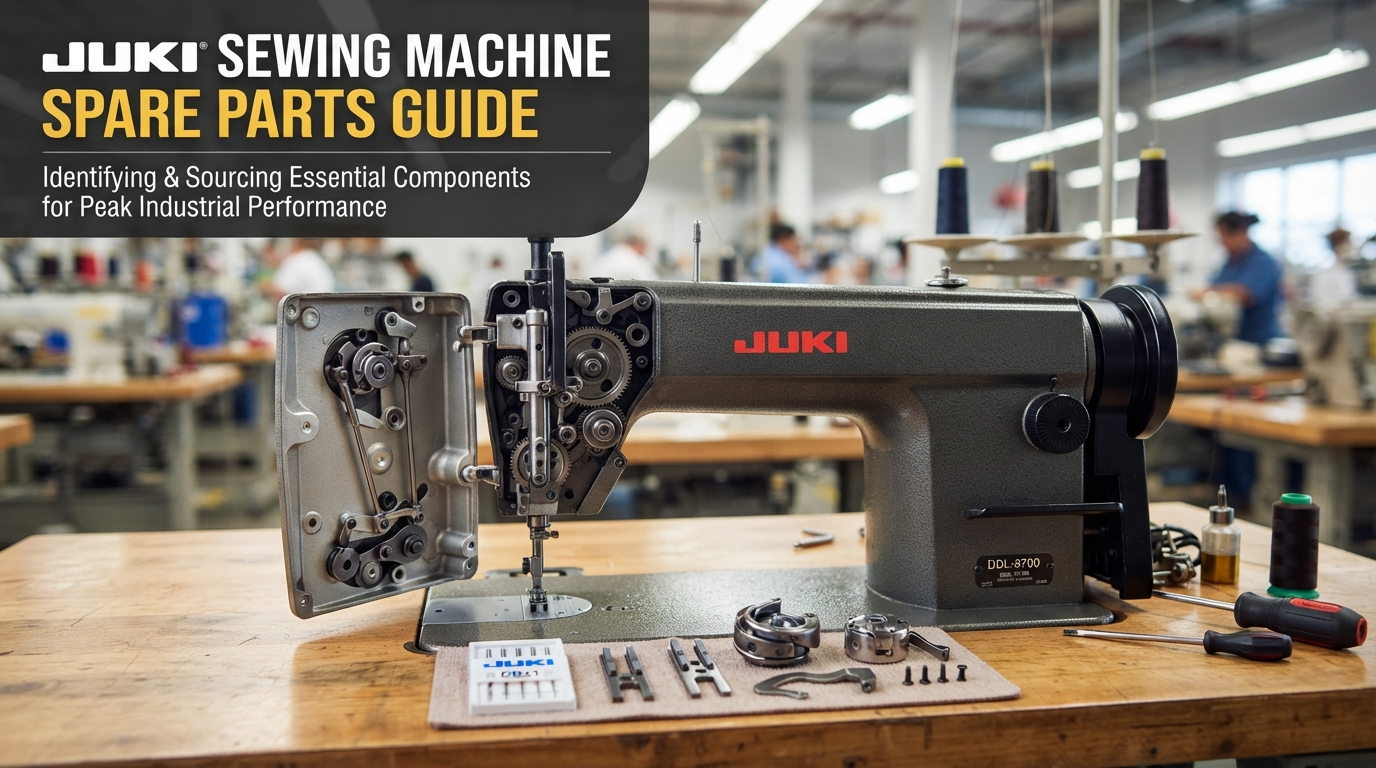
Juki is the world's most widely used brand of industrial sewing machines. Their DDL (single-needle lock stitch) series – especially the Juki DDL-5550, DDL-8700, and DDL-9000 – powers garment factories from Pakistan and Bangladesh to Turkey and Vietnam.
But even the best machines wear out. Knowing which parts fail first, why they fail, and how to replace them is the difference between a 2-minute fix and a costly machine-down situation. This guide covers every key Juki sewing machine spare part in plain language.
1. Upper Thread System Parts
The upper thread travels from the cone, through a series of guides and tension components, over the take-up lever, and down to the needle. Every point where it touches a metal surface is a wear point.
Thread Guides (Three-Hole Guide, Upper Thread Guide, Presser Bar Thread Guide)
Thread guides route the thread along the correct path. Over time, the thread wears grooves into the guide holes. These grooves have sharp edges that shred the thread, causing breakage. Replace thread guides when you see grooves or if a cotton ball snags on the hole.
Common Juki DDL thread guide types:
- Three-hole guide – the wire guide on the machine arm with three holes that gives the thread three routing points
- Upper thread guide – individual guide on the head assembly
- Presser bar thread guide – the guide that clips onto the presser bar, routing thread to the needle clamp
Eye Rubber (Thread Guide Grommet)
The eye rubber is a small rubber grommet that cushions thread as it passes through guide holes. Without it, thread runs on bare metal. At 5,500 stitches per minute on a Juki DDL-5550, this causes rapid thread abrasion.
Eye rubbers are cheap, consumable parts that should be checked every 3 months and replaced when cracked or hardened.
Tension Post Auto Head
The tension post on the machine head creates the resistance that gives the upper thread its correct tension. If it is grooved or bent, tension becomes inconsistent – too tight causes thread breakage, too loose causes loops on the underside of the fabric. Replace when you notice tension problems that can't be resolved by adjusting the tension dial.
2. Needle Bar Assembly
Needle Bar Stud (Juki DDL-5550 L/S)
The needle bar stud supports the needle bar and keeps it aligned on the correct vertical axis. A worn stud allows the needle bar to wobble laterally – by even a fraction of a millimetre – which causes the needle to strike the needle plate hole edge, resulting in needle breakage.
The Juki DDL-5550 uses an L/S (Long Shaft / Short Shaft) variant. Always verify which variant your machine uses before ordering.
Needle Bar
The needle bar is the vertical bar that carries the needle clamp and needle, driving them down with each stitch cycle. Needle bars rarely fail in isolation but wear over years. Symptoms: needle wobble, needle striking the throat plate, inconsistent stitch depth.
3. Presser Foot System
Presser Foot (P952 and variants)
The presser foot presses the fabric flat against the feed dog so it feeds correctly. The bottom sole of the presser foot wears smooth and can develop scratches that mark delicate fabrics. In production use, plan to replace the presser foot every 6–12 months.
The P952 is the standard straight-stitch presser foot for Juki DDL machines. Speciality feet (zipper, walking, Teflon, roller) are available for specific applications.
Presser Bar
The presser bar is the steel bar inside the head that holds the presser foot clamp and delivers the spring pressure down to the foot. It must be straight and smooth to slide freely in its bushing. A bent or scored presser bar causes binding and uneven foot pressure. Test by removing the foot and raising/lowering the bar by hand – it should glide with no resistance.
Pressure Cap Iron
Above the presser spring in the presser bar housing sits the iron pressure cap. It retains the spring and works with the pressure adjustment thumbscrew. A cracked or missing pressure cap makes foot pressure adjustment impossible.
Hand Lifter
The hand lifter is the lever at the back of the machine head used to raise the presser foot for fabric positioning. A broken hand lifter forces operators to improvise, slowing production. It is an inexpensive part that should be replaced immediately if damaged.
4. Bobbin System
Slide Plate (Needle Plate Cover)
The slide plate is the removable panel over the bobbin area. It slides left to give access to the bobbin for changes. A warped, cracked, or missing slide plate allows lint to enter the hook area, affects stitch quality, and slows bobbin changes. It is one of the most visually obvious parts to check during machine inspection.
5. Threading & Guiding Parts
Cone Keli (Thread Spool Pin)
"Keli" is the common Pakistani and South Asian industry term for the spool pin – the vertical pin on top of the machine that holds the thread cone. A bent or broken cone keli causes the cone to wobble, creating inconsistent thread tension and tangling.
This is an extremely inexpensive part that many operators overlook when diagnosing tension problems. Check it first.
Frame Guide
The frame guide helps position fabric or seam edges for consistent seam allowances. In production sewing, this guide ensures operators maintain straight stitch lines without measuring every seam. A missing guide increases error rates and slows production.
6. Lubrication System
Oil Seal
The oil seal is a rubber ring seal around the main shaft and hook area that keeps machine oil inside the machine. When the oil seal hardens and cracks (typically after 2–3 years of production use), machine oil leaks onto the needle plate and from there onto garments – causing expensive fabric staining and defects.
Oil seal replacement is the most important preventive maintenance item on a Juki DDL machine. If you see oil stains on fabric, check the oil seals first. Replacement requires partial disassembly – best done by a technician.
7. Take-Up System
Take-Up Lever Kundi Cover (White)
The white plastic cover on the take-up lever ("kundi" = knob/cover in Pakistani trade terminology) protects the lever pivot from lint and makes the thread path visible when threading the machine. A cracked or missing cover allows lint to jam the pivot and makes threading difficult. It is a cheap consumable – replace it when damaged.
Head Take-Up Component
The take-up mechanism components work together to loop the upper thread around the hook and pull it up to form the lock stitch. Problems here cause loose stitches, thread loops on the underside, or skipped stitches. Any irregularity in the take-up motion requires immediate attention.
Juki Spare Parts Maintenance Schedule
| Part | Replacement Interval | Signs of Wear |
|---|---|---|
| Needle | Every 8–10 sewing hours | Thread breaking, skipped stitches, fabric snagging |
| Eye Rubber | Every 3–6 months | Thread breaking at guide holes |
| Thread Guides | Every 6 months / when grooved | Thread breakage, grooves visible, cotton ball snags |
| Presser Foot | Every 6–12 months | Fabric snagging, sole scratches, uneven feeding |
| Oil Seal | Every 2–3 years | Oil stains on fabric |
| Presser Bar | When worn / binding | Stiff presser foot movement, uneven pressure |
| Tension Post | When tension is inconsistent | Tension problems not resolved by dial adjustment |
| Cone Keli (Spool Pin) | When bent / broken | Cone wobbling, thread tangling |
Where to Buy Genuine Juki Spare Parts Wholesale from Pakistan
SA Embroidery is Pakistan's leading wholesale exporter of Juki sewing machine spare parts and industrial sewing machine components. We have been supplying factories, distributors, and repair shops worldwide for over a decade.
What We Supply
- Tension post auto heads for Juki DDL series
- Thread guides (single hole, three hole, presser bar guides)
- Eye rubbers (in bulk packs)
- Slide plates for Juki DDL machines
- Presser feet (P952 and specialty feet)
- Cone keli (spool pins)
- Needle bar studs (model-specific, including DDL-5550 L/S)
- Presser bars and pressure cap irons
- Hand lifters and knee lifters
- Oil seals (individual and multipacks)
- Take-up lever covers and take-up components
- And hundreds more Juki and industrial sewing machine spare parts
Shipping to Your Country
We export via FedEx and DHL Express to:
- UAE / Dubai – 3–5 business days
- Saudi Arabia / Gulf countries – 3–5 business days
- United Kingdom – 4–7 business days
- United States – 5–7 business days
- Worldwide – contact us for delivery estimates
Get a Wholesale Quote
To get pricing, send us your Juki machine model number and a list of parts needed via WhatsApp at +92-316-793-7030 or use the quote form on our website. We respond within 24 hours with pricing and availability.
Pro Tip: Keep a maintenance kit stocked with the most frequently replaced Juki parts – needles, eye rubbers, thread guides, presser feet, and a set of oil seals. This prevents machine downtime when a part fails during production. SA Embroidery can supply a custom maintenance kit pack for your Juki machine models at wholesale pricing.
Need embroidery machine parts?
WhatsApp us. We respond within 24 hours, Mon–Sat
Frequently Asked Questions
Common questions about this topic
1Which Juki sewing machine parts wear out most frequently?
The most frequently replaced Juki spare parts are: needles (after every 8–10 hours of use), eye rubbers and thread guides (every 3–6 months), presser feet (every 6–12 months in production use), oil seals (every 2–3 years), and tension discs (when tension becomes inconsistent). Smaller items like cone keli pins, slide plates and cover pieces are replaced as needed when damaged.
2Where can I buy genuine Juki DDL spare parts wholesale?
SA Embroidery is Pakistan's trusted wholesale exporter of Juki sewing machine spare parts. We supply factories, repair shops and distributors in UAE, UK, USA, Saudi Arabia, Kuwait, Qatar, Bahrain and Oman. Contact us via WhatsApp (+92-316-793-7030) or the quote form on our website for bulk pricing.
3How do I identify which Juki machine model I have?
Check the metal plate on the front of the machine head. It will show the model (e.g. DDL-5550, DDL-8700N, DDL-9000C) and serial number. Always quote this model number when ordering spare parts to ensure correct compatibility.
4Can I use the same spare parts for Juki DDL-5550 and DDL-8700?
Some parts are cross-compatible between Juki DDL-5550 and DDL-8700 (e.g. standard thread guides, eye rubbers, oil seals) while others are model-specific (e.g. needle bar stud, presser bar, hook assembly). Always confirm compatibility with your machine model number before ordering.
5How often should I service a Juki DDL sewing machine?
For production use (8+ hours/day), service your Juki DDL machine every 3 months: clean lint from the hook and feed dog area, oil the machine according to the Juki manual, inspect and replace thread guides and eye rubbers, check the oil seals for leaks, and verify needle bar and presser bar movement is smooth. Replace the needle after every 8–10 hours of stitching.
6Do you ship Juki spare parts internationally from Pakistan?
Yes. SA Embroidery ships all Juki sewing machine spare parts worldwide via FedEx and DHL Express. Standard delivery to UAE (Dubai) takes 3–5 days, to UK and Europe 4–7 days, to USA 5–7 days, and to Saudi Arabia and Gulf countries 3–5 days. We handle all export documentation.